

In our latest Edge Thinkers’ article, we hear from Beth Knight – a leading global expert in social impact and sustainability.
Beth would like to thank the (CISL)’s AI4Good Alumni network for their inputs and contributions to this article.
The Real ‘AI Bubble’: Beyond Hype to Societal Value
As headlines fixate on an ‘AI bubble’ and the dazzling promise of machine-driven productivity and profit, it’s easy for leaders to overlook another equally critical frontier: AI’s potential to drive sustainability and unlock long-term societal value. The real question facing Boards and executives is not just ‘How can AI create economic returns?’ but ‘Can it deliver these gains responsibly by advancing environmental stewardship and social inclusion alongside efficiency and growth?’ In this age of AI acceleration, success belongs to those who recognise this broader mandate: harnessing AI for both competitive advantage and the greater good.
Why This Matters Now
As digital innovation accelerates, organisations face an unprecedented moment to harness AI as a catalyst for resilience, transparency, and positive societal transformation. Regulators, investors, and customers are demanding clearer evidence that AI delivers real environmental, social, and governance (ESG) gains on top of profits. When strategically integrated, Responsible AI and digital sustainability have the power to unlock new value, deepen stakeholder trust, and help build a regenerative economy grounded in ethics and evidence.
From Measurement to Material Impact
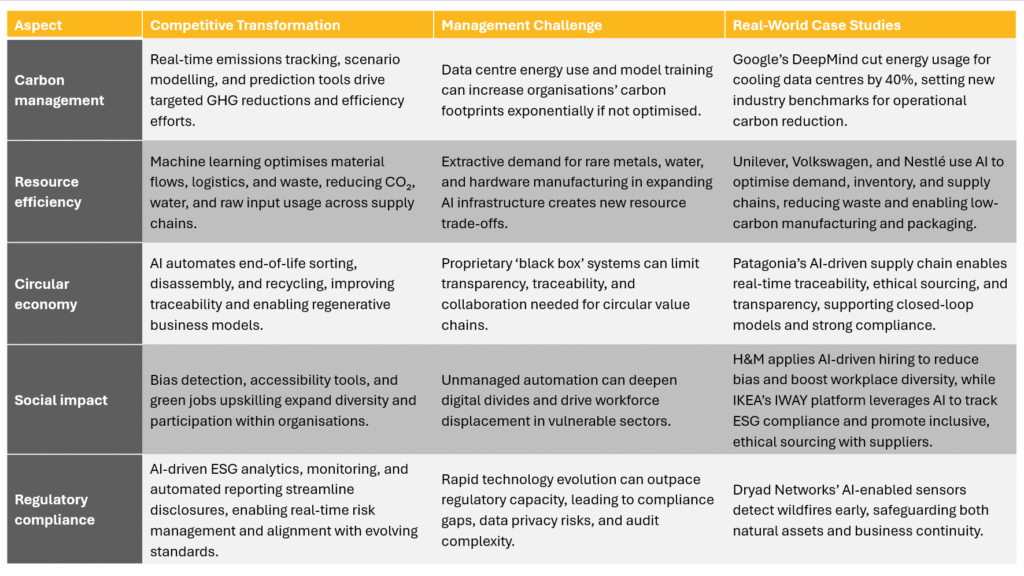
AI-powered tools are not only redefining how we measure sustainability performance but also enabling businesses to embrace sustainability as a source of competitive advantage. The positive examples are plentiful: from automating environmental disclosures and real-time emissions monitoring, to strengthening supply chain transparency, designing responsible products, empowering workforce upskilling, and supporting inclusive hiring.
Pragmatic AI adoption across sectors is projected to reduce corporate carbon emissions by 5–10% by 2030[i], while generating $2.6–4.4 trillion in global economic value annually[ii]. Organisations embedding AI into sustainability strategies report 11–14% increased investor confidence, up to 9% higher long-term return on equity (ROE), and a 15–17% reduction in regulatory and reputational risks.[iii]
Yet these gains are tempered by emerging challenges. For example, short-term economic gains can be undermined by unintended environmental consequences. Large language models, data centre energy use and ‘black box’ system risks have the potential to undermine hard-won sustainability gains unless we tackle the difficult leadership decisions head-on.
Let’s explore some of the most prominent tensions…
The Road to ‘Responsible AI’ Governance
Digital sustainability stewardship goes well beyond compliance. UK academic initiatives such as the Sustainable AI Futures project and the University of Cambridge’s Frugal AI Hub[iv] offer practical toolkits to govern AI’s environmental footprint through its lifecycle (from optimising code to building climate-conscious data centres). These frameworks empower organisations to measure and mitigate AI’s true cost, positioning responsible governance as an essential part of social license and long-term value creation.
The regulatory landscape is shifting to support this stewardship. The EU AI Act[v] sets clear mandates on lifecycle environmental impact, energy efficiency, and transparency. Article 40 of the Act calls for harmonised standards, designed to encourage innovation with a focus on resource performance, and fosters international collaboration through mechanisms such as regulatory sandboxes. These changes signal a move towards stewardship where regulation, best practice, and business strategy converge.
Global entities such as the United Nations International Computing Centre (UNICC) exemplify how ‘AI 4 Good’ efforts are aligning technological innovation with ethical governance and stakeholder engagement to tackle climate, biodiversity, and equity challenges at scale[vi]. Measurement tools like the Montreal AI Ethics Institute’s Digital and Green Index (DGI) is translating abstract principles into accessible, data-driven impact ratings which stakeholders are engaging with as the next evolution of eco-labelling[vii].
In the UK, Business in the Community’s (BITC) Responsible AI Blueprint further grounds governance in collaborative, sector-tailored workshops and case studies[viii]. Complimenting this, AI-powered recruitment and upskilling tools are reducing bias and expanding access to green jobs and meaningful workforce inclusion.
What distinguishes best-in-class leaders?
- Customer trust and new offerings: Organisations applying AI for supply chain transparency and responsible product personalisation are outperforming laggards in retention and Net Promoter Scores.
- Supplier and partner collaboration: Real-time digital auditing of ESG metrics enables closer partnerships and collective risk-sharing, opening access to premium markets and sustainable finance.
- Workforce empowerment: Companies that invest in digital skills, ethical AI, and inclusive innovation see higher employee retention and innovation metrics, particularly among next-generation talent.
Five Critical Actions for Leaders
- Measure rigorously: Use trusted, science-based frameworks and reporting tools for AI and digital sustainability impacts, using trusted academic measures for added rigour.
- Incentivise shared value: Connect measurable digital sustainability outcomes to leadership and employee incentives.
- Innovate responsibly: Prioritise ‘frugal’ AI and sector-specific solutions via lean, efficient tech informed by leading practice cases.
- Test and scale: Build multidisciplinary teams for Responsible AI agile pilots, fail fast and scale working methods.
- Engage authentically: Use open dialogue, transparent reporting, and inclusive design principles to co-create solutions, drive adoption, resilience, and trust.
Call to Action: Leading from the Future
The decisions leaders make now will shape the trajectory of AI’s role in creating a regenerative, net-positive future (versus inadvertently amplifying existing risks). Responsible AI and digital sustainability must be foundational pillars of business strategy and investment. The evidence is clear: organisations pursuing integrated digital sustainability and responsible AI strategies are making real, measurable progress that catalyses transformation and stakeholder value when guided by purpose, transparency, and robust governance.
Forward-thinking leaders must act decisively now to harness the AI opportunity whilst embedding long-term value that advances business, society, and the planet simultaneously. This integration promises to deliver resilient growth, stakeholder trust, and lasting impact in the digital century.

To find out more about Beth’s work, please visit: https://www.bethknight.earth/
To see more updates from Next Up expert network, please visit our edge thinkers page on our website: https://nextupforesight.com/edge-thinking/
References:
[iii] World Economic Forum, Responsible AI Playbook for Investors (2024); EY, Global Institutional Investor Survey (2024)
[v] EU AI Act Regulation – EU – 2024/1689 – EN – EUR-Lex
[vi] AI for Good Global Summit – United Nations
[vii] Toward Responsible AI Use: Montreal AI Ethics Institute
[viii] Responsible AI Blueprint – BITC
Wider Sources:
AI and Sustainability: Opportunities, Challenges, and Impact – EY
AI at Work: Friend or Foe – BCG
AI and Project Governance: Building Future Skills in Finance – GFT
AI and Sustainability in Practice – Turing Institute
AI and Sustainability Power of Integration – Bain & Co
AI for a Sustainable Future: Opportunities, Challenges, and Critical Conversations – Kingston
AI for Good Global Summit – United Nations
AI Opportunities and Challenges – UNFCCC
AI Sustainability in Practice – UCL
AI x Sustainability: Business Opportunities and Challenges – Plymouth
AlgorithmWatch SustAIn Magazine 2022
Best Practices for the Sustainable Use of AI and LLMs – GreenPlaces
BSI Guidance on AI Sustainability
Business Guide to Responsible and Sustainable AI – BSR
Can AI and Sustainability Co-exist? – Queen Mary University of London
Carbon Footprint of ChatGPT – Sustainability by Numbers
Corporate Reporting: AI Transparency and Corporate Responsibility – PwC
Defra Digital Sustainability Strategy 2025–2030
Digital Sustainability and Responsible AI Reporting – Womble Bond Dickinson
Energy and AI – A Quick Q&A – Faster Please
Environmental Impacts and Carbon Cost of AI – Solve Ethics
Environmental Impacts of AI: Positive or Negative? – Codo.jp
Environmental Impacts of AI: A New Challenge for Local Government – Local Partnerships
Foundations for Environmentally Sustainable AI – Royal Academy of Engineering
Green Growth Metrics: Tracking Sustainability ROI in Your AI Stack – M ACCELERATOR by M Studio
Hiyield: Is AI the Enemy of Sustainability?
How AI Use Impacts the Environment – World Economic Forum
IBM: 10 AI Dangers and Risks and How to Manage Them
ICAEW Cyber Security Tops Business Risks, but AI on the Rise
LinkedIn: Can AI Become Sustainable? – John Elkington
Measuring the Environmental Impacts of Artificial Intelligence – OECD
National Centre for AI: Artificial Intelligence and the Environment – Jisc
Responsible AI Blueprint – BITC
Sustainable AI in Practice – AlgorithmWatch
Related Blogs and Podcasts to follow:
ERM: Sustainable Connections Podcast – How to Sell Business on Sustainability